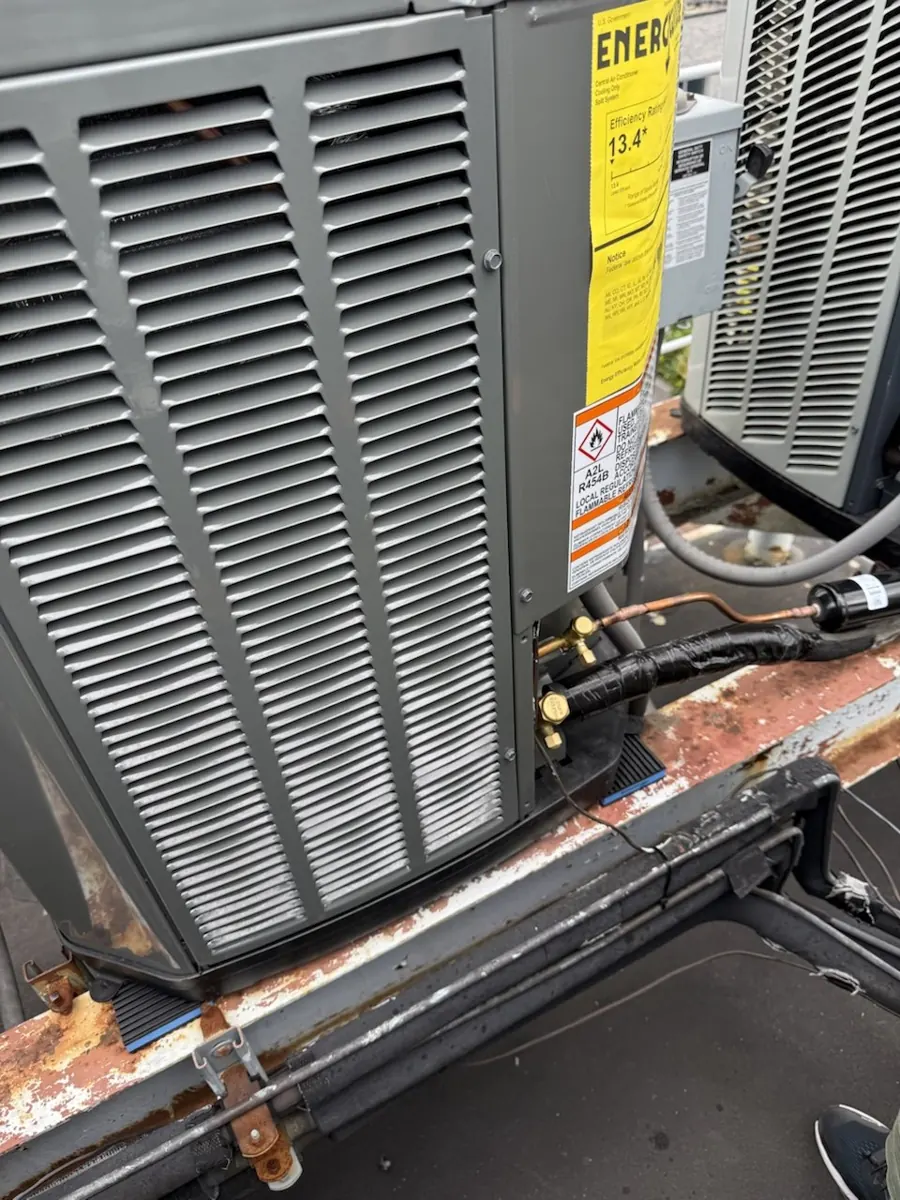
If you have heard that your air conditioner's refrigerant is being "banned," here is the plain version. The R-410A phase-out means that new home AC and heat pump systems manufactured from January 1, 2025 use lower-GWP A2L refrigerants, mainly R-454B and R-32. Your existing R-410A system is still legal to run and can still be repaired. What changes is the long-term cost of R-410A, what you can buy when you replace, and how carefully a repair-or-replace decision should be made.
This guide explains what the rule actually covers, what it means for homeowners in Los Angeles and the San Fernando Valley, and the mistakes to avoid, including the "just swap in the new refrigerant" shortcut that does not exist.
What the R-410A phase-out actually is
R-410A has been the standard refrigerant in residential central air, heat pumps and mini splits for years. It replaced R-22 because it does not harm the ozone layer. The problem is that R-410A is a hydrofluorocarbon (HFC) with a high global warming potential (GWP) if it leaks into the atmosphere.
Under the federal AIM Act, the EPA is doing two things at once:
- Phasing down HFC production and imports. Less new R-410A enters the market over time. Supply shrinks gradually rather than stopping overnight.
- Restricting high-GWP refrigerants in new equipment. New residential AC and heat pump systems manufactured from January 1, 2025 must use lower-GWP refrigerants. Manufacturers were given a limited window to install previously built R-410A equipment, and new installations today are A2L systems.
California has pursued its own climate rules on refrigerants for years, which lines up with the federal direction. For a homeowner, the practical result is the same: new systems use A2L refrigerants, and R-410A is what you keep servicing in the equipment you already own.
For the official background, the EPA website has current information on the AIM Act and refrigerant transitions.
Can my R-410A system still be repaired? Yes.
This is the most important point, and it is where some homeowners get pushed into a replacement they do not need. Nothing in the R-410A phase-out makes your existing system illegal to operate or to fix. Technicians can still:
- Diagnose and repair refrigerant leaks
- Recharge the system with R-410A after a repair
- Replace capacitors, contactors, fan motors, control boards and other parts
- Replace a failed compressor or coil, where that makes sense for the age and condition of the system
If a contractor tells you your system "cannot be serviced anymore" because of the phase-out, that is not accurate. A healthy R-410A system that is maintained properly can keep cooling your home for years. Our guide to AC maintenance in the San Fernando Valley covers how to keep it that way.
Why R-410A will likely get more expensive
Because production and imports are being stepped down while millions of existing systems still need it, R-410A is expected to face cost pressure over time. Recovered and reclaimed refrigerant will make up a growing share of the supply. We are not going to predict prices, but the direction is clear: refrigerant-heavy repairs on R-410A systems are likely to cost more in the future than they used to.
That has a practical consequence. "Topping off" a leaking system every summer was always a bad idea. With R-410A, it gets worse each year. If your system is low, it is leaking, and the leak should be found and fixed.
"These guys brought my split system back to life after some installers messed it upand its only two years old! They found the leak and fixed everything in one day. They did an amazing job!"
Arina D. · Google
What are A2L refrigerants? R-454B vs R-32
"A2L" is a safety classification. The "A" means lower toxicity. The "2L" means mildly flammable: these refrigerants are hard to ignite and burn slowly compared to truly flammable gases, but they are not completely non-flammable like R-410A.
| R-410A | R-454B | R-32 | |
|---|---|---|---|
| Status for new home systems | Being phased out for new equipment | Used in many new central systems | Used in many new systems, common in ductless |
| Global warming potential | High | Much lower | Much lower |
| Safety class | A1 (non-flammable) | A2L (mildly flammable) | A2L (mildly flammable) |
| Can existing systems be repaired? | Yes | Yes | Yes |
| Interchangeable with the others? | No | No | No |
Which one you get depends on the manufacturer. Some brands chose R-454B for their central systems; others, including many ductless and mini-split lines, use R-32. Both are legitimate choices. What matters more is the quality of the equipment and, above all, the quality of the installation.
Why you cannot just swap refrigerant into an old system
One of the most common questions we hear is, "Can't you just put the new refrigerant in my existing unit?" The answer is no, for several reasons:
- Different properties. A2L refrigerants operate at different pressures and temperatures. Compressors, metering devices and controls are engineered around a specific refrigerant.
- Matched components. New A2L systems are designed and tested as a matched set of outdoor unit and indoor coil or air handler. You cannot keep an old R-410A indoor coil and pair it with a new A2L outdoor unit.
- Safety design. A2L equipment includes features that older R-410A equipment does not have, such as refrigerant leak detection in many indoor units.
- Nameplate rules. Every system is labeled for one refrigerant. Charging it with something else is improper and can damage the equipment.
The same applies the other way around: R-454B and R-32 are not interchangeable with each other. And mixing refrigerants in one system is never acceptable. If anyone offers a "drop-in" substitute to avoid a proper repair, ask hard questions.
Want a pro to take a look?
$55 service call with code LA55 — inspection, diagnosis and a clear price before any work. Open 7 days · 8 AM – 10 PM.
A2L safety: what homeowners should understand
Mild flammability sounds alarming, but A2L refrigerants have been used safely in many parts of the world for years, and US codes and product standards have been updated around them. Here is what makes them safe in practice:
Design safeguards in the equipment
- Leak detection. Many A2L indoor units include a refrigerant sensor. If it detects a leak, the system can run the blower to dilute the refrigerant and shut down the compressor.
- Charge limits. Codes limit how much refrigerant can be used relative to the size of the space it serves.
- Components rated to avoid ignition sources in the areas where refrigerant could collect.
Trained installers and the right tools
A2L refrigerants call for updated practices: proper ventilation during work, tools and recovery equipment rated for A2L use, careful brazing practices, thorough leak testing and correct labeling. Anyone handling refrigerant must already meet EPA Section 608 requirements, and A2L work adds more on top of that. When you get quotes for a new system, it is fair to ask how the installer handles A2L equipment.
Placement and code requirements
Equipment location, room size and ventilation can matter with A2L systems, especially for indoor units in small rooms, closets and ADUs. That is one more reason a proper load calculation and permit are not optional on a replacement. Our guide to HVAC permits and Title 24 in Los Angeles explains what the permit and inspection process usually involve.
Smell gas? Different problem. Refrigerants are not natural gas. If you smell rotten eggs near a gas furnace, water heater or stove, leave the house and contact SoCalGas or 911 from outside. If you suspect a refrigerant leak (ice on lines, a hissing sound, an AC that stopped cooling), turn the system off and call an HVAC technician.
Repair or replace? How the phase-out changes the math
The phase-out should not push you into replacing a healthy system. It does change the calculation when something big fails. Here is a practical way to think about it:
When repairing an R-410A system usually makes sense
- The system is relatively young and has been reliable.
- The problem is electrical or mechanical (capacitor, contactor, fan motor, board, thermostat) and does not involve a large amount of refrigerant.
- A leak is small, accessible and can be repaired properly.
- The home is comfortable and the system was sized correctly in the first place.
When replacement deserves a serious look
- The compressor has failed on an older system.
- There is a large or recurring leak, especially in the indoor or outdoor coil, which means a big refrigerant bill on top of the repair.
- The system has needed repeated repairs, or comfort was never good.
- Ductwork in the attic is old and leaky, so you would be paying to cool the attic regardless.
Our full repair-or-replace guide for Los Angeles walks through the decision in detail, including how to read quotes.
What replacing with an A2L system involves
Replacing an R-410A system is not just swapping a box. In most cases, the outdoor unit and the indoor coil or air handler are replaced together as a matched A2L system. Whether existing refrigerant lines can be reused depends on their size, condition and the manufacturer's instructions. The job generally needs a mechanical permit (LADBS in the City of LA, or your city's own building department in Burbank, Glendale, Pasadena, Beverly Hills or West Hollywood), and California's Title 24 energy code may require HERS verification depending on scope.
It is also a good moment to reconsider the system type. Many LA homes are well suited to a heat pump, which handles both cooling and heating, or to ductless mini splits for homes without good ducts.
Red flags to watch for during the transition
- "Your system is illegal now." It is not. Existing R-410A equipment can be operated and repaired.
- Repeated refrigerant top-offs with no leak search. You keep paying for refrigerant that is leaking out.
- A quote with no model numbers. You should know exactly which outdoor unit and indoor coil you are getting and which refrigerant they use.
- Mixing old and new components, such as keeping an R-410A coil with a new A2L condenser.
- No permit. Skipping the permit on a refrigerant system replacement is a shortcut that can come back to bite you when you sell the home.
How Back2Cool handles R-410A and A2L systems
Back2Cool HVAC is a Sherman Oaks company with 12 years of experience on central AC, heat pumps and mini splits across Los Angeles, from Sherman Oaks to Glendale and Pasadena. Our approach is straightforward:
- We diagnose the root cause, including finding leaks instead of just adding refrigerant, and explain the findings and your options before any approved work.
- If repairing your R-410A system is the sensible choice, we say so. We recommend only the work needed to restore safe, reliable operation.
- When replacement makes sense, we size the system with a load calculation, pull the permit, handle Title 24 testing and file utility rebate paperwork, and we provide a written quote with exact model numbers before work starts.
- Our lead tech has completed specialized training courses with Mitsubishi Electric, Daikin and Fujitsu.
Not sure what refrigerant you have? Send us a photo of your outdoor unit's nameplate and we will tell you straight whether it needs replacing or just a repair. Or book an inspection: our $55 service call with code LA55 includes inspection, diagnosis and clear recommendations, and the $55 is applied toward the repair if you go ahead. Call (626) 635-4095, 7 days a week from 8:00 AM to 10:00 PM, or schedule AC repair online.