Should you repair or replace your AC in Los Angeles? Repair it when the problem is a common part (a capacitor, contactor, fan motor or control board), the system is reasonably young and it has kept your home comfortable. Consider replacement when an older system needs a major repair such as a compressor or a large coil leak, when it has failed repeatedly, when it never cooled the house properly, or when the ductwork is so leaky that a new system would still underperform.
That is the short version. The details matter, because an AC decision in LA also involves refrigerant changes, permits, Title 24 rules and some contractors who would rather sell you a new unit than fix the one you have. Here is a clear framework you can use before you sign anything.
Start with the diagnosis, not the sales pitch
Every good repair-or-replace decision starts with an accurate diagnosis. "Your system is old" is not a diagnosis. You should know which part failed, why it failed and what else is at risk. A failed capacitor caused by age and heat is a routine fix. A compressor that failed because the system was low on refrigerant for years points to a leak that must be found first.
If you have been told you need a new system, ask the technician to show you the failed component and explain the root cause. If the answer is vague, that is your cue to get a second opinion. Our guide to why an AC is not cooling explains the most common causes, many of which are inexpensive repairs.
The repair-or-replace decision framework
No single rule fits every home, so look at these factors together.
| Factor | Leans toward repair | Leans toward replacement |
|---|---|---|
| Age and condition | Relatively young, good repair history | Old, with recurring breakdowns |
| Type of failure | Capacitor, contactor, fan motor, board, thermostat, small accessible leak | Compressor, major coil leak, multiple failures at once |
| Refrigerant | Problem does not involve much refrigerant | Large R-410A leak or recharge on an aging system |
| Comfort | Home cooled well before the breakdown | Hot rooms, humidity, constant running, short cycling |
| Sizing | System was sized correctly | Oversized or undersized from the start |
| Ductwork | Ducts in decent shape | Old, leaky or crushed ducts in a hot attic |
| Efficiency and bills | Bills reasonable for your home | Bills keep climbing even after maintenance |
Age: important, but not the whole story
Age matters because older systems have more worn parts and are less efficient than modern equipment rated under today's SEER2 standards. But age is a weaker signal in LA than you might think. A system in a shaded Hollywood duplex may see a fraction of the runtime of one on a west-facing Van Nuys ranch house. Condition, repair history and how hard the system has worked matter as much as the year on the nameplate.
Refrigerant type
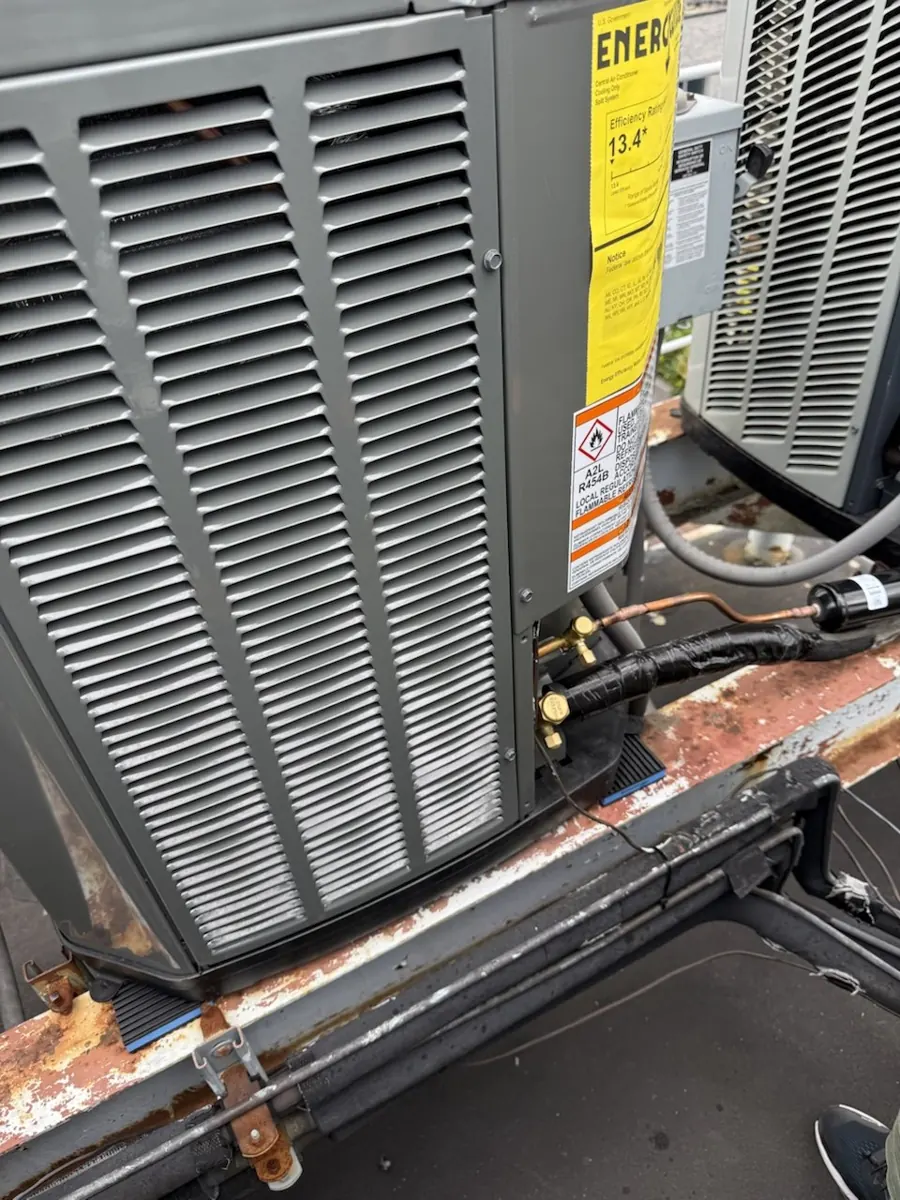
New home systems manufactured from January 1, 2025 use A2L refrigerants such as R-454B or R-32. Existing R-410A systems can still be serviced and repaired, but R-410A supply is being phased down, so it can get pricier over time. For a small electrical repair, refrigerant does not matter much. For a big leak on an older R-410A system, it can be the deciding factor. Our guide to the R-410A phase-out explains the details.
If your system is old enough to use R-22, the older refrigerant that was phased out before R-410A, a major repair rarely makes sense.
Repair cost vs value: the "$5,000 rule"
A well-known rule of thumb in the HVAC industry is the "$5,000 rule": multiply the age of your system in years by the cost of the repair. If the result is above 5,000, replacement deserves a serious look. If it is well below, repair usually makes sense.
The idea behind it is sensible. The older the equipment, the less of its useful life is left, so the same repair buys you less time. Treat it as a conversation starter, not a verdict. It ignores comfort problems, sizing errors, duct condition, refrigerant type and rebates, all of which can change the answer.
Comfort problems and sizing errors
If your home was never comfortable, repairing the current system just restores a bad situation. Common signs of a sizing problem:
- Oversized: short cycling, cold blasts followed by stuffy air, clammy humidity, uneven rooms.
- Undersized: runs nonstop on hot afternoons and still cannot hold the setpoint.
Many systems in LA were sized by rule of thumb or by matching whatever was there before. A proper load calculation looks at the house itself: insulation, windows, orientation, air leakage and ductwork.
Ductwork condition
Many 1920s through 1960s homes in Los Angeles have old ducts in hot attics or crawlspaces. Leaky, crushed or poorly insulated ducts can rob a new system of much of its performance. If you replace equipment, the ducts must be evaluated at the same time. In some older homes without workable ducts, ductless mini splits or a heat pump may be a better path than a like-for-like replacement. See our mini split vs central air guide.
"AC died on me in the middle of that heat wave... called these guys in the morning and someone was out by the afternoon. The tech was super nice, showed me what the problem was and didn't try to upsell me on a whole new unit like the last company did. Fixed it in about an hour, and the price was reasonable. House is finally cool again lol. Will def use them again!!"
Danny G. · Thumbtack
Want a pro to take a look?
$55 service call with code LA55 — inspection, diagnosis and a clear price before any work. Open 7 days · 8 AM – 10 PM.
What an AC replacement involves in Los Angeles
If replacement is the right call, a proper job in LA involves more than setting a new box on a pad. These are the steps that separate a solid installation from a cheap one.
1. A load calculation
A Manual J-style load calculation determines how much cooling and heating the home actually needs. It prevents both oversizing and undersizing, and it should drive the equipment choice rather than the size of the old unit.
2. The right equipment, matched as a system
With A2L refrigerants, the outdoor unit and indoor coil or air handler are designed to work as a matched set. Whether existing refrigerant lines can be reused depends on their size, condition and the manufacturer's instructions. California is in the DOE Southwest region, which has higher minimum efficiency requirements for central AC.
3. A permit
AC and heat pump replacement in LA generally needs a mechanical permit. In the City of LA that comes from LADBS; Burbank, Glendale, Pasadena, Beverly Hills and West Hollywood each have their own building departments. The permit protects you, and unpermitted work can surface as a problem when you sell.
4. Title 24 and HERS verification
California's Title 24 Part 6 energy code applies to HVAC changeouts. Depending on scope, HERS verification of items such as refrigerant charge, duct leakage and airflow may be required. Our guide to HVAC permits and Title 24 in Los Angeles covers this in depth.
5. Rebates
Utilities such as LADWP, SCE, Burbank Water and Power, Glendale Water & Power and Pasadena Water and Power have offered rebates on efficient equipment and heat pumps, and the programs change. Check current offers before you sign, since some require specific paperwork.
6. Startup and verification
The installer should start the system, check refrigerant charge and airflow, confirm the thermostat and drainage work, and walk you through operation before leaving.
Red flags in AC replacement quotes
- No load calculation. The size was copied from the old unit or guessed.
- No permit mentioned, or an offer to save money by skipping it.
- Vague equipment descriptions like "3-ton high-efficiency system" without exact model numbers for the outdoor unit and indoor coil.
- No mention of Title 24 or HERS testing on a job where it likely applies.
- Replacement recommended without showing the failed part or explaining the root cause.
- Pressure to decide today or a price that only holds for the next hour.
- Old indoor coil kept with a new outdoor unit, especially across refrigerant types.
- No plan for the ducts in an older home with attic ductwork.
- "Your R-410A system can't be repaired anymore." That is not true.
A good quote is written, lists exact model numbers, describes the scope (including permit, testing, duct work, haul-away of old equipment and cleanup) and makes clear what is and is not included.
Get a second opinion without the hassle: take a clear photo of your outdoor unit's nameplate, your indoor unit, and the quote you received. A trustworthy contractor can often tell you from that whether the recommendation makes sense, or whether the system deserves a proper inspection before you commit to replacing it.
How to get an honest second opinion
- Ask for the diagnosis in writing: the failed component, the root cause and the measurements behind it.
- Send photos: the outdoor unit's nameplate (model, serial and refrigerant), the indoor unit and the quote.
- Compare scope, not just price: one quote may include the permit, load calculation, Title 24 testing and a new indoor coil, and another may not.
- Ask about repair options even if replacement was recommended, and what each would mean for the next few summers.
How Back2Cool handles repair-or-replace decisions
Back2Cool HVAC has served Los Angeles homes for 12 years from our base in Sherman Oaks, including Encino, Burbank, Beverly Hills and the wider Los Angeles area.
- Send us a photo of your system and we will tell you straight whether it needs replacing or just a repair.
- On site, we listen, inspect, diagnose the root cause and explain findings and options with clear pricing before any approved work.
- We recommend only the work needed to restore safe, reliable operation. No upselling.
- When replacement is the right call, we size the system with a load calculation, pull the permit, handle Title 24 testing and file utility rebate paperwork, the steps cheaper bids quietly skip.
- You get a written quote with exact model numbers before work starts. Floors are covered, the site is cleaned daily and old equipment is hauled away.
Start with our $55 service call using code LA55: a system inspection, diagnosis and clear recommendations, with the $55 applied toward the repair if you go ahead. Call (626) 635-4095, 7 days a week from 8:00 AM to 10:00 PM, or explore AC repair and AC installation.